
Piles Explained: Grades, Symptoms and What Treatment Each One Needs
Piles are graded one to four, and that grade largely determines whether you need fibre, a five-minute clinic procedure, or day-care surgery. Here is how to know where you stand.
Piles are among the most common conditions in surgical practice and among the most delayed. Patients routinely describe living with bleeding for two, five, sometimes ten years before seeking help, usually out of embarrassment and often after trying every advertised remedy first.
Part of the problem is that “piles” is used as a catch-all for any anal symptom. Understanding what haemorrhoids actually are, and how they are graded, makes the treatment options much clearer.
What haemorrhoids actually are
Everyone has haemorrhoids. They are normal cushions of blood vessels in the anal canal that contribute to fine continence — the mechanism that lets you distinguish gas from stool and hold on when necessary.
They become a medical problem when chronic straining causes the supporting tissue to stretch, the cushions to engorge, and eventually to slide downward. So the correct way to think about “having piles” is not that something abnormal has grown, but that a normal structure has been displaced and enlarged.
Internal versus external
The dentate line divides the anal canal into two zones with entirely different nerve supply, and this explains the symptoms.
Internal haemorrhoids arise above it, in tissue with very few pain fibres. This is why classic internal piles bleed profusely but do not hurt — a fact that confuses patients who assume anything painless cannot be serious.
External haemorrhoids arise below it, in skin richly supplied with pain nerves. These hurt, itch and can be felt as a lump. Many patients have both.
The four grades, and what each needs
Grading is based purely on prolapse — how far the pile comes out — and it drives treatment more than any other single factor.
- Grade I: bleeding only, no prolapse. Treated with fibre, water, stool softeners and correcting toilet habits. Medication for symptomatic flares. Most patients never need anything more if they make the changes.
- Grade II: prolapse on straining, returns spontaneously. Rubber band ligation in the clinic works very well here, as does laser treatment. This is the stage at which intervention is simplest and most effective.
- Grade III: prolapse that must be pushed back manually. Now beyond banding for most patients. Laser haemorrhoidoplasty or stapler haemorrhoidopexy is usually indicated.
- Grade IV: permanently prolapsed, cannot be reduced. Requires surgery — laser, stapler, or in extensive mixed disease a formal excisional haemorrhoidectomy, sometimes combined.
The symptoms worth taking seriously
- Bright red blood on the paper, dripping into the pan, or coating the stool
- A soft lump appearing at the anus during defaecation
- Itching, moistness or mucus discharge
- A sensation that the bowel has not fully emptied
- Pain — usually meaning external, thrombosed or prolapsed piles rather than simple internal ones
- Tiredness and breathlessness, which can indicate anaemia from long-standing blood loss
The most important caveat in this entire article
Rectal bleeding is also how colorectal cancer, polyps, inflammatory bowel disease and anal fissure present. A significant number of colorectal cancers are diagnosed late precisely because the bleeding was assumed to be piles — by the patient, and sometimes by a clinician who did not examine properly.
No one should be treated for piles on assumption. A proper examination including proctoscopy takes a few minutes. And colonoscopy is recommended for anyone over forty-five with rectal bleeding, and at any age where there is weight loss, a change in bowel habit, anaemia, or a family history of bowel cancer.
Non-surgical treatment: what actually works
For grade I and many grade II piles, conservative management is genuinely effective — but only if it is done properly rather than half-heartedly.
- Fibre: aim for 25 to 30 grams a day. Isabgol (psyllium husk) is the most reliable and best-studied supplement
- Water: two to three litres daily. Fibre without adequate water makes constipation worse, not better
- Toilet habit: no more than three to five minutes, and no phone. Prolonged sitting on a toilet seat causes the cushions to engorge
- Do not suppress the urge — postponing makes stool harder
- Sitz baths in warm water for ten minutes, twice daily, during flares
- Oral phlebotonics such as micronised flavonoids reduce bleeding in acute episodes
- Topical creams give symptomatic relief but do not treat the underlying prolapse
Procedures, from smallest to largest
- Rubber band ligation: a two-minute outpatient procedure, no anaesthesia. A band cuts off the blood supply to the pile which shrinks and falls off in about a week. Excellent for grades I–II
- Laser haemorrhoidoplasty: a fibre delivers energy inside the pile, shrinking it and causing it to fibrose and retract. No cutting of anal skin, no open wound, day care, back to desk work in two to four days
- Stapler haemorrhoidopexy (MIPH): a circular stapler removes a ring of tissue above the pain-sensitive zone and lifts the prolapsed cushions back into position. Well suited to circumferential grade III–IV prolapse
- Open haemorrhoidectomy: excision of the pile masses. The most definitive procedure and still the right choice for large grade IV mixed piles, at the cost of a longer and more uncomfortable recovery
Why treatment fails, when it fails
Recurrence after any piles procedure is largely determined by what happens afterwards. Surgery removes or shrinks the cushions that are prolapsed today. It does not change your bowel habit.
Patients who return to chronic constipation, straining and twenty minutes on the toilet with a phone will frequently develop symptoms again within a few years. Those who maintain fibre, fluids and short toilet visits generally do not.
This is not a disclaimer. It is the single most useful thing to know about the condition — and it is why every treatment plan starts with diet regardless of which procedure follows.
When to see a surgeon rather than wait
- Any rectal bleeding, however minor, that has not been properly examined
- A lump at the anus that no longer goes back
- Bleeding accompanied by weight loss, altered bowel habit or anaemia
- Sudden severe anal pain with a hard bluish lump — a thrombosed pile, which can be relieved quickly
- Symptoms that have not improved after six to eight weeks of genuine dietary change
Need this assessed? Read the full treatment page for laser piles (haemorrhoids) treatment, or book an appointment at Dynamic Surgical Hospital, Ahmedabad.
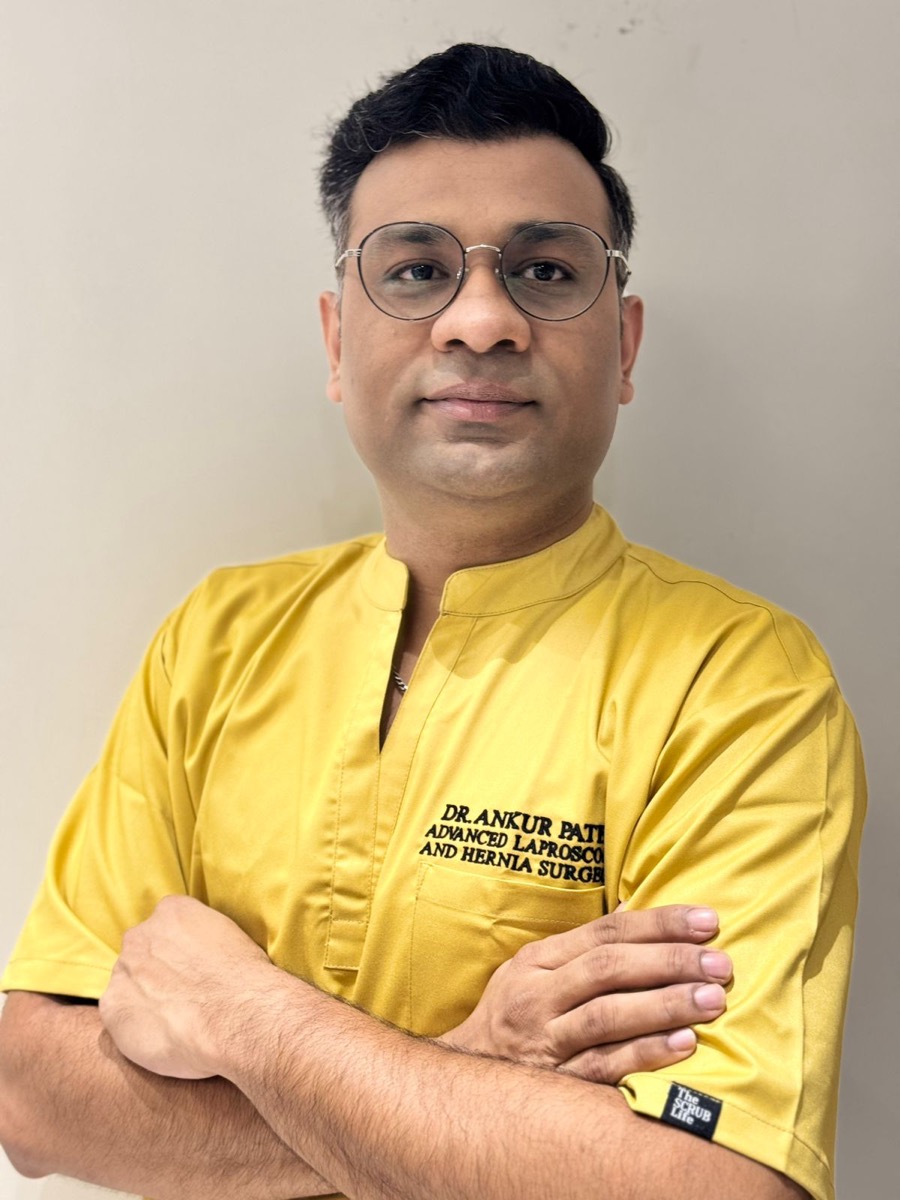
Dr. Ankur Patel
MBBS, MS (General Surgery), FMAS, FALS, DIPMAS, FACRSI
Dr. Ankur Patel is an advanced laparoscopic and robotic surgeon practising in Ahmedabad, with 15+ years of experience in minimally invasive and complex abdominal surgery. His work centres on hernia repair, gallbladder and appendix surgery, laser proctology and gastrointestinal procedures performed through keyhole techniques that shorten hospital stays and speed up recovery.
Read full profile →Medical disclaimer: This article is general patient education and is not a substitute for individual medical advice. Symptoms that seem similar can have very different causes, and only an examination can establish what is actually going on in your case. Please consult a qualified doctor and discuss your symptoms to better understand your condition and the right next steps for you. If you may be having a medical emergency, go to the nearest hospital.