
Recovery After Hernia Surgery: A Realistic Week-by-Week Guide
What actually happens in the days and weeks after laparoscopic hernia repair — including the shoulder pain nobody warns you about, when you can drive, and why week three is when most people overdo it.
The single most common question before hernia surgery is not about risk. It is “when can I get back to normal”. The honest answer has several parts, because “normal” means different things for a software engineer and for someone who loads goods for a living.
Here is what recovery after a laparoscopic mesh repair actually looks like.
Day 0 — the day of surgery
You wake in the recovery area within minutes of the operation finishing. Most patients are surprised by how quickly they are alert.
Within two to three hours you will be encouraged to sit up and sip water. Walking to the bathroom usually happens the same evening, and this is deliberate — early walking reduces the risk of clots, chest problems and urinary retention.
You may feel an ache in the shoulder tips. This is one of the most commonly under-explained parts of laparoscopic surgery: it comes from residual carbon dioxide irritating the underside of the diaphragm, which shares nerve supply with the shoulder. It is not a shoulder problem, it is harmless, and it settles in one to two days. Walking helps it clear faster.
Most patients are discharged the same evening or the next morning.
Days 1 to 3 — the sore phase
Expect moderate soreness around the ports and a fullness or tightness in the groin. Simple painkillers control it in the great majority of cases.
Some bruising in the groin, and in men some scrotal swelling and discolouration, is normal and can look alarming. It typically peaks around day three and resolves over one to two weeks. Supportive underwear helps considerably.
Eat normally. Keep the dressings dry. Walk around the house several times a day rather than sitting for long stretches.
- Do: walk regularly, in short frequent bouts
- Do: take painkillers on schedule for the first two days rather than waiting for pain
- Do: use a stool softener if you are prone to constipation — straining is the last thing you want
- Avoid: lifting anything heavier than about five kilograms
- Avoid: soaking the wounds in a bath or swimming
Days 4 to 7 — turning the corner
Most patients notice a distinct improvement in this window. Showering is usually allowed once cleared, typically from around day two to three with waterproof dressings.
Driving becomes reasonable when you can perform an emergency stop without hesitating because of pain, and when you are off any sedating painkillers. For most people that is somewhere between day four and day seven for short local journeys.
Desk-based work is commonly resumed at the end of the first week, sometimes from home a little earlier. If your work is physically demanding, this is not the week for it.
Weeks 2 to 4 — the deceptive phase
By week two most patients feel largely fine, and this is precisely where problems arise. Feeling well is not the same as being healed.
The mesh takes several weeks to become properly incorporated into the tissue by fibrous ingrowth. During that period it is held in place by the fixation and by the pressure of the abdominal contents, not yet by biological integration. Heavy lifting in week three is one of the more avoidable causes of early recurrence.
Keep the five-kilogram limit until you are reviewed, usually at three to four weeks. Increase your walking freely — walking is actively good for you. Avoid gym work, abdominal exercises, running and sport until cleared.
Weeks 4 to 6 — back to full activity
After your follow-up review, most patients are cleared for gym, sport, manual work and unrestricted lifting. Return to strength training gradually rather than at your previous weights — give yourself two to three weeks of building back up.
A degree of tightness or awareness in the groin can persist for two to three months, and occasionally a firm ridge can be felt where the mesh sits. Both are normal.
What is normal, and what is not
Some things that worry patients are entirely expected. Others are worth a phone call.
- Normal: bruising, mild swelling at the repair site, shoulder-tip ache for a day or two, a firm lump under the wound that softens over weeks
- Normal: a fluid swelling (seroma) at the site in the first weeks, which usually resolves without treatment
- Call the clinic: fever above 38°C, spreading redness around a wound, or pus discharge
- Call the clinic: pain that is increasing rather than decreasing after day three
- Call the clinic: inability to pass urine — more common in older men and easily treated
- Call the clinic: persistent vomiting, or no passage of gas or stool with a distended abdomen
The things that genuinely affect your outcome
Two patients with identical hernias and identical operations can have quite different long-term results, and the difference is usually in these factors.
- Stopping smoking — nicotine impairs collagen formation and measurably raises recurrence risk
- Controlling blood sugar if you are diabetic — this affects both healing and infection risk
- Treating a chronic cough, whether from asthma, bronchitis or smoking, before and after surgery
- Avoiding constipation, with fibre and fluids from day one
- Losing weight where relevant, which reduces the constant load on the repair
- Respecting the lifting restriction for the full four weeks, even when you feel fine at two
A note on expectations
Recovery is not linear. Most patients have a day somewhere in the first fortnight where they feel worse than the day before, usually after doing too much. That is not a setback in any meaningful sense; it is feedback.
If anything about your recovery does not match what you were told to expect, ask. It is far easier to reassure someone over a phone call than to manage a problem that went unmentioned for a week.
Need this assessed? Read the full treatment page for laparoscopic & robotic hernia surgery, or book an appointment at Dynamic Surgical Hospital, Ahmedabad.
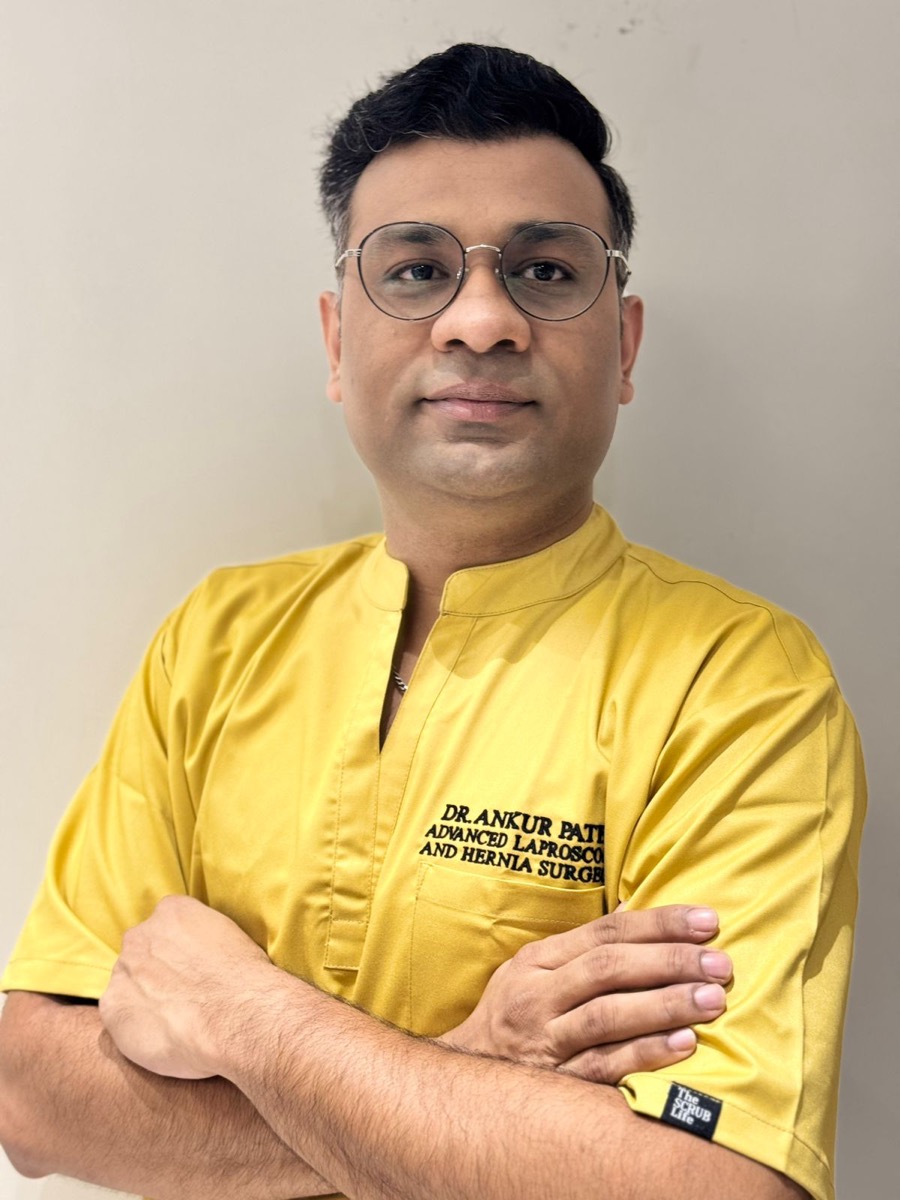
Dr. Ankur Patel
MBBS, MS (General Surgery), FMAS, FALS, DIPMAS, FACRSI
Dr. Ankur Patel is an advanced laparoscopic and robotic surgeon practising in Ahmedabad, with 15+ years of experience in minimally invasive and complex abdominal surgery. His work centres on hernia repair, gallbladder and appendix surgery, laser proctology and gastrointestinal procedures performed through keyhole techniques that shorten hospital stays and speed up recovery.
Read full profile →Medical disclaimer: This article is general patient education and is not a substitute for individual medical advice. Symptoms that seem similar can have very different causes, and only an examination can establish what is actually going on in your case. Please consult a qualified doctor and discuss your symptoms to better understand your condition and the right next steps for you. If you may be having a medical emergency, go to the nearest hospital.